
How Did Women Sneak Into Hollywood?
Cinema IS editing. That wasn't obvious at the beginning; it took time for early film-makers to discover what was uniquely powerful about the new medium. Early moving pictures were mainly visual recordings of stage routines, done in one shot. By the 1920s, the power of what you cut from and to was starting to be understood and a new art form emerged.
But a lot of men in the studios hadn't realised. Editing, they thought, was just a process of stitching together the strips of film. So they let women do it. And that was the crack in the door into which women inserted a foot.
I stumbled across this fact while making my 10 min short Your Actual Relationship. It was an ultra-low budget, one-scene, one-room comedy. I wanted a way to hook the viewer in to a story that was just three people talking in a room.
What I settled on was the idea of letting the audience hear some of the scene before they see it. Just a line. Nothing amazing or shocking but enough to make the viewer think 'What is that? Show me what's going on'. Then we jump into the middle of a conversation two people are having.
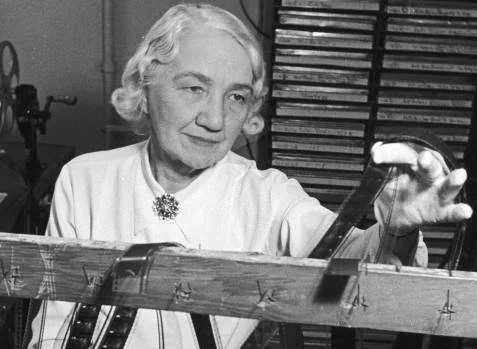
Anne Bauchens
Film-making lesson number one: When you're writing a story, a scene, whatever, it's a good idea to hurl your reader as far into the story/scene as you can. The audience will catch up. More importantly, they will want to catch up, because they feel they've missed something. I talk about it more in this vlog.
Joining a scene halfway through was something I had, as a writer, already known about. But allowing the audience to hear the scene before they see it – and beginning the film that way – was something I was discovering through directing and editing for the first time.
I soon realised that I must have got the idea when I re-watched Reservoir Dogs a few weeks before making the short. (Not for any reason, I was just watching a few old classics with my teenage son.) And it seemed obvious that I must have taken the idea of 'sound first, picture second' from Tarantino – or possibly the editor, Sally Menke.
Imagine Tarantino's position. He's a first-time film-maker. He wants attention. He wants to blow everyone away. He wants people to stop doing whatever the hell they're doing and watch this film now with 100% focus.
So he starts with a couple of lines of dialogue over a blank black screen. We wonder what's going on. Then he puts us in the passenger seat of a getaway car. The man in the back is bleeding from his gut. He's whimpering and begging to be taken to hospital. His squirming smears blood all over the cream-coloured upholstery. The driver reaches back and holds his hand. He clearly cares about the wounded man – but he isn't going to the hospital. We wonder: 'What's going on? How did this poor guy get hurt? Why can't he be taken to hospital?'. We're on board. Well done, Quentin. Or maybe, Sally.
Then I got interested in where they got the idea from. Check out the beginning of Sidney Lumet's Serpico. Almost the same and undoubtedly an influence. Also edited by a woman. And that's when I started to get curious and stumbled across a well-established fact that I'd been ignorant of: women have been at the forefront of film-editing from the start.
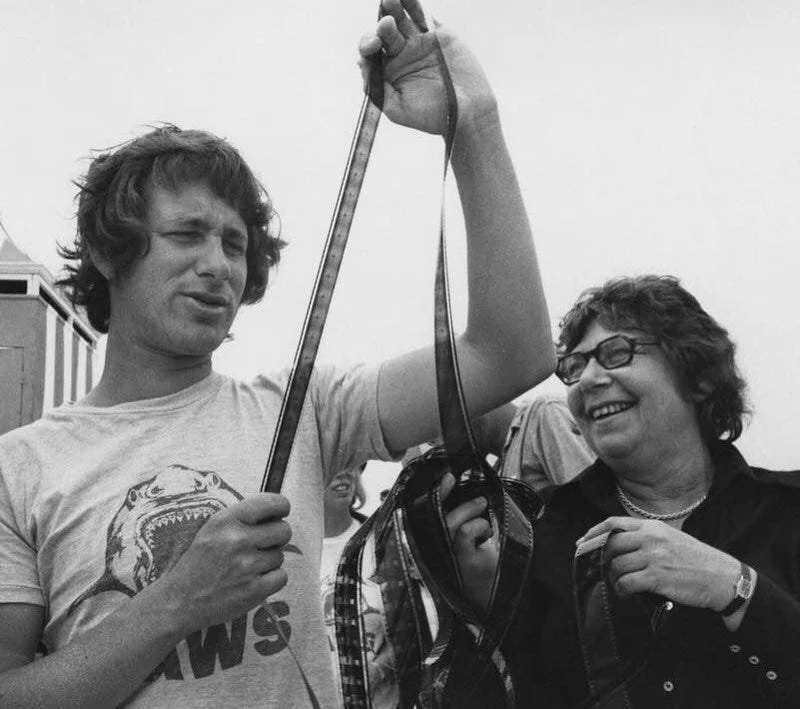
Verna Fields with Steven Spielberg
Even to this day, and certainly for the whole of the twentieth century, women have been excluded from pretty much every part of the decision-making process in films. The directors, the directors of photography, producers and screenwriters have almost always been men. It's got a little bit better but not much. In the mid-twentieth century, some of the big female acting stars wrestled a modicum of control from the bosses: Bette Davis, Joan Crawford, Barbara Stanwyck and others knew that women – the biggest cinema-goers – were packing cinemas to see them. And they used that fact to get better scripts, more serious parts, and sometimes more money. They were able to negotiate, to some extent, because they were the big draw.
But the editors… they didn't have that capital on their side. How did they do it?
Thelma Schoonmaker (9 Oscar nominations, 3 wins) speculated that editing is collaborative and women have fewer ego problems, which allows them to serve the process rather than try to impose their own will. I reckon there must be more to it.
As I said, the door seems to have been ajar in the first place because the studios initially overlooked the vital role of editing. Maybe I’d add the fact that by editing and re-editing a scene women could really prove their value: a scene that lacked life suddenly acquired it because the editor figured out the right order and timing of the shots to bring us into the emotion of the scene. Directors and producers would have been forced to accept the evidence of their own eyes.
However these women did it, they did it. And it's worth emphasising: women weren't just in the editing game; they were at the very top of it, from the start. Here are some of the things that we know women did, against all the odds:
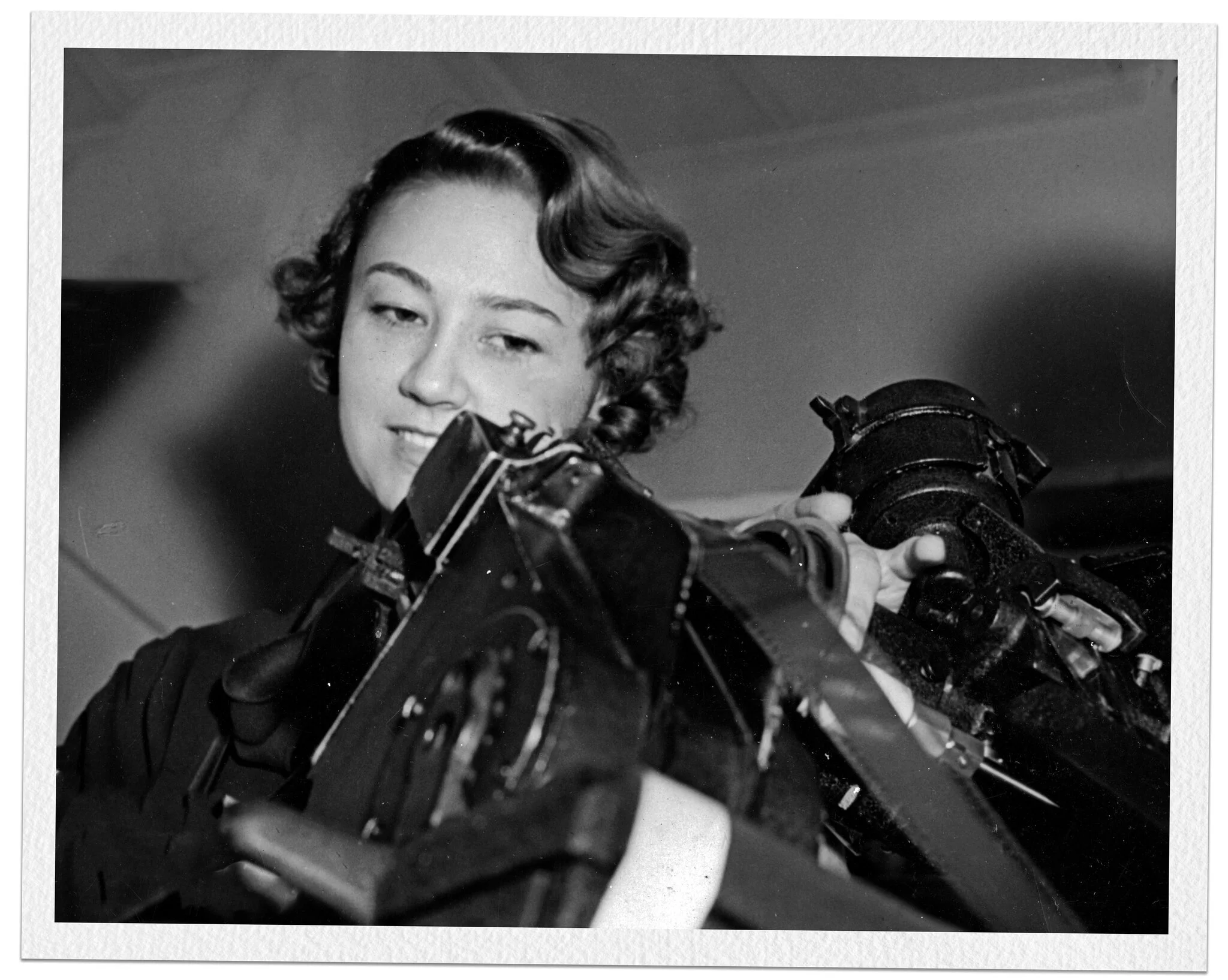
Dorothy Spencer
Margaret Booth started in 1910 as a 'patcher' for DW Griffith – the top director of the day – and may have become the first ever credited 'editor' – male or female, in 1915.
If it wasn’t Booth, it was Anne Bauchens. Bauchens made 40 films with the titan Cecil B. DeMille between 1918 and 1956, when his name was literally synonymous with epics. He wouldn't work with anyone else.
Dorothy Spencer cut films for Elia Kazan, Alfred Hitchcock and John Ford. These were absolute giants of the medium and could have worked with anyone they wanted, which means she was a giant too, but less known.
Barbara McLean was at 20th Century Fox from 1933 to 1969, getting 7 Oscar nominations and winning once.
Anne V. Coates spent more than 60 years editing films. She worked alongside directors like Sidney Lumet, Milos Forman, David Lynch and Steven Soderbergh. Five Oscar nominations, one win – for Lawrence Of Arabia, no less.
In that 1962 film, two of Coates's masterstrokes have gone down in history. The first is a cut from a match being blown out to the blazing desert sun. Originally, it was supposed to be a dissolve – with the flame fading into the sun. But the abrupt jolt of the jump cut (borrowed from the style of the French new wave) had a jarring effect that she and Lean decided to retain.
And then perhaps the most famous scene of the film. It really is worth watching. When the character of Ali appears, he's initially only visible as a shimmer. Coates resisted the temptation to cover the approach with dramatic music as would have been the norm. Instead, she allows the quiet of the desert and the galloping hooves, gradually growing louder, to build suspense, until Ali arrives and immediately does something unexpected. It's pure cinema.
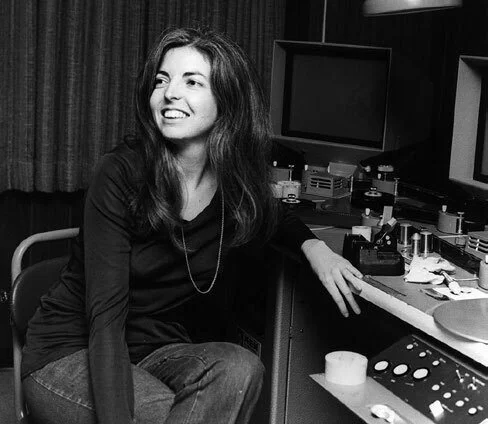
Thelma Schoonmaker
Film-making tip number 2: the best bit of your film will often be the bit that you can only do in a film – that wouldn't be possible on radio, in a novel, or on stage.
These pioneers were followed in the 60s and 70s by Verna Fields, the already-mentioned Thelma Schoonmaker and Dede Allen. Fields edited the early films of George Lucas, Steven Spielberg, and Peter Bogdanovich. Schoonmaker edited almost every film Martin Scorsese made.
Dede Allen's style of editing the shootouts in Bonnie and Clyde (1967) was something entirely new. Unlike a traditional shootout that you might see in a Western, where you see a character take aim, fire… and then cut to what they're firing at, the deadly finale of this film is a confusing flurry of shots – camera shots and gun shots – that leave the doomed couple in an ugly slump.
Film-making Lesson Number 3: Make the audience feel like a character in the scene In an action scene you might want the audience to lose the thread of the action – to feel overwhelmed. This makes them feel they are IN the shootout, caught in the crossfire. It may make them feel morally compromised, complicit in what's happening. Or you might want the audience to be taking cover. In a lot of the old Western films we are onlookers, spying on the action from behind a barrel or under the floorboards. There are plenty of scenes where this literally happens – we see one of the townsfolk cowering then adopt their point of view. Emotionally, this makes us feel helpless, but morally, we are not to blame for what's taking place.
Studio boss Jack Warner thought it was too hard to follow and fired her. The film's star and co-producer, Warren Beatty, kept her on with money from his own pocket and gave her the first ever solo editing credit (i.e. when the credits roll you see only her name on the screen, not grouped with other names). That confusing, bewildering, cross-cutting action style is now standard. Dede Allen invented it.
In 1973, Allen went on to edit Pacino in Serpico, whose opening scene influenced Reservoir Dogs, which was where I picked up the idea for my short.
I guess I know who to thank.
