
How Coppola Puts You In The Mafia
I read the novel of The Godfather last week. It was a blockbuster when it came out and Francis Ford Coppola’s film followed hard on its heels, the screenplay written by the novelist himself, Mario Puzo.
The film is a reference point for writers and directors. If you read about how to make a great film, The Godfather is likely to come up and some point: the lighting, the camerawork, the performances, the editing… all of it sets the standards for the medium. Here, I’m going to draw attention to something very instructive that I haven’t read anywhere else.
By the way, I’m going to assume you know the film but maybe not the book.
What caught my attention was what didn’t make it from the book to the film. And I think the differences tell us a lot about how books differ from films. And there is one scene in particular that captures perfectly why the film is a masterpiece.
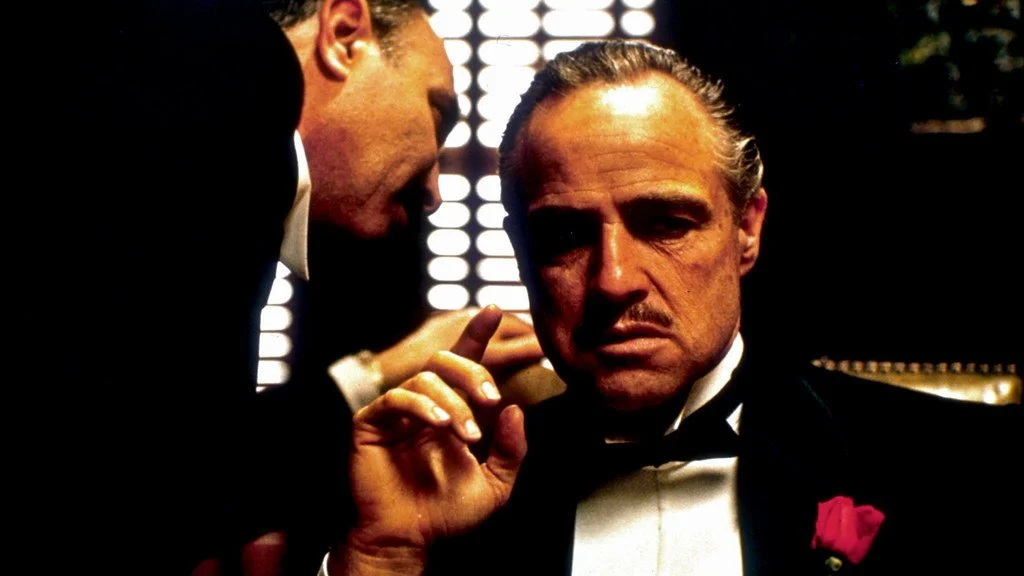
General points first. The book has a lot of extra stuff about characters in Las Vegas; the film strips most of this out. The book also takes its time when Michael, the protagonist of the story, is in exile in Sicily whereas, while the films follows the Sicily plot exactly, it trims that action right down.
And that’s exactly what you’d expect. Why?
Key difference number one:
A film is designed to be consumed in one sitting, whereas the reading of a novel is broken up. This means that the unity of the story is essential in a film. The delicate dramatic structure is the key to the experience. The pace and tension must be carefully maintained. With a novel, however, you pick it up and put it down, rejoining the story at intervals. Naturally, the same is true of a long-running TV series to some extent: the plot can go down side alleys and pick up the main narrative again later.
Even when I’m reading a thriller, I notice (as a screenwriter) how much latitude the author has. As long as the book delivers cliffhangers every few pages, it doesn’t matter as much which character you’re spending time with and how far away from the main action you are. Drama (whether for the screen or stage) demands a tighter focus.
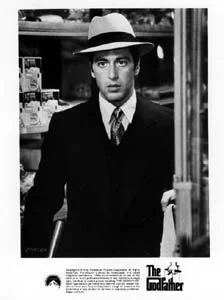
So it’s no surprise that Coppola and Puzo decided to focus on the New York action and strip out as much as possible of what happens outside that claustrophobic mafia world. (I must admit I do wonder how the conversations went – did Puzo push for all the material to stay in and Coppola overrule him? Maybe I should re-read Easy Riders, Raging Bulls).
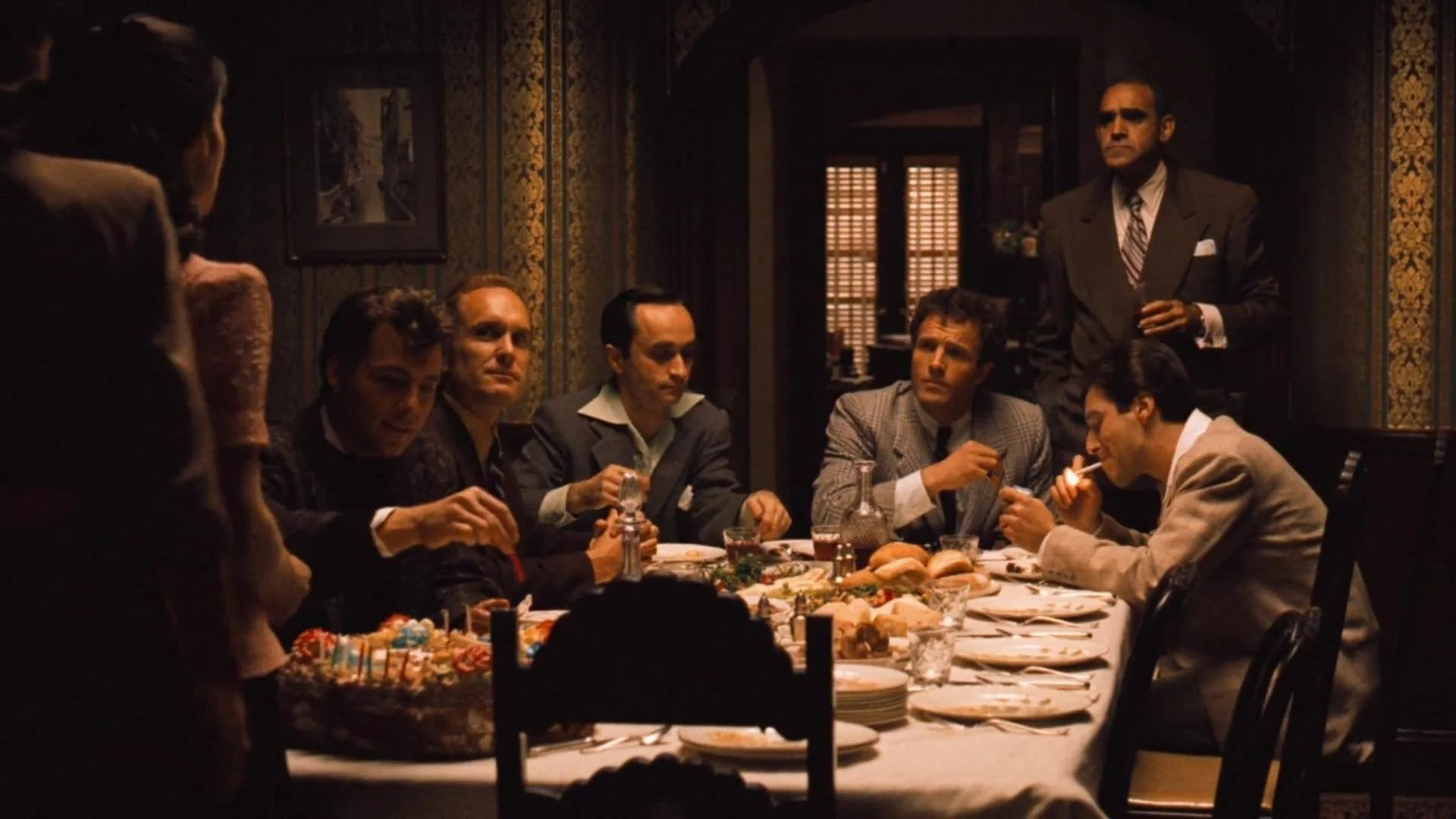
The finale of the film is spectacular – a true orgy of violence, as Michael’s pitiless vengeance is enacted in multiple locations simultaneously. Coppola cuts from one killing to another, piling up the horror. But because he’s managed, by this time, to get us around to Michael’s side… (OK, you might have to speak for yourself here, when you see the film you might be repelled by the character before now, but I wasn’t) … we are kind of almost willing these murders to occur while at the same time finding them brutal and extreme.
That’s not all Coppola does though. He intercuts the violence, which we realise Michael has planned and directed, with Michael attending a church service, standing as Godfather to his sister’s son – renouncing the Devil and all his works – while elsewhere the baby’s father (Michael’s brother-in-law) is one of those being slaughtered.
Key difference number two:
Cinema IS cutting. It gets its power from the juxtaposition of images. The last shot we saw powers the shot we are seeing now. This shot we’re seeing now powers the next one, and so on. The effect is cumulative, sometimes a bit mysterious, but undoubted.
When Puzo narrates the same section of the story in the novel, he doesn’t juxtapose. There’s no point. It wouldn’t have the same effect. So Michael becomes a literal Godfather in the chapter before he becomes a mafia godfather. It works fine. But it can’t compete with the tour de force of the movie’s sequence.
But none of that is how Coppola puts you in the mafia. He does that with what – I think – is the only scene in the movie that is not in the book at all. And it tells you a hell of a lot about how stories, and films in particular, work.
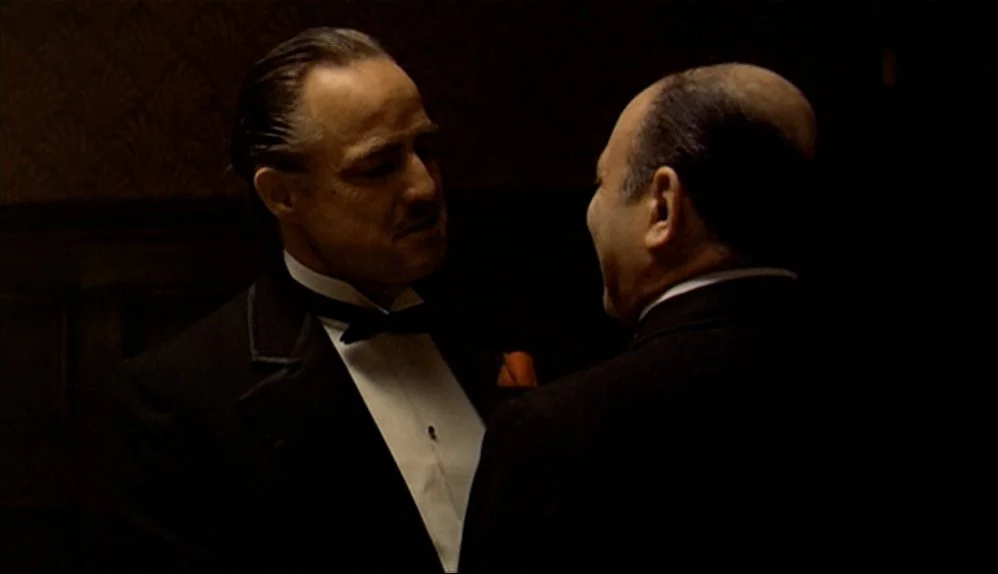
Towards the end of the film, Vito Corleone – the original Godfather – is semi-retired, growing tomatoes in his garden, a symbolic return to the innocence of farming in Sicily. His son Michael is receiving advice as he prepares to take over the empire, completing a diabolical apprenticeship in strategy, psychology, and the economy of fear.
The old man tells his son one big thing. He says that there will be a traitor in the organisation. The traitor will be paid by a rival family to engineer a meeting or rendez-vous under the pretence of striking a deal. But at that meeting Michael will be assassinated. The traitor, Vito leans close and murmurs, will be… the one who comes to you with the deal. Watch that moment here (3:15).
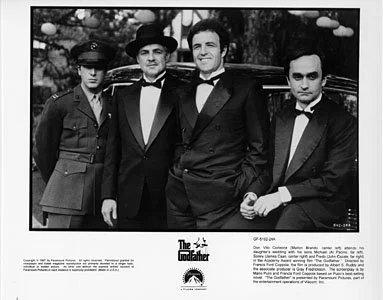
Vito passes away soon afterwards. When one of the lieutenants, Tessio, then approaches Michael with the news that one of the rival families wants to talk… then we know. We know that Tessio is the traitor. We’re thinking ‘Watch out, Michael! That’s him! He’s the traitor!’. We share secret knowledge with Michael; only we and he know this. We’re on the inside – because it’s a secret organisation and we are in possession of its innermost secret. And maybe, just maybe, we’re excited to be there, however immoral we know it to be. In fact, the more immoral it is, the more excited we are. The complicity is delicious.
There is a practical writing principle at work here. I heard Jez Butterworth call this ‘triangles’. I can’t claim to represent his exact insight but my understanding is that it works like this…
There are three people in the situation: You the audience, Character 1, and Character 2. Drama comes from splitting the triangle so that two of those parties know something that the other doesn’t. This can work in any number of ways but let’s look at some examples:
Let’s say we know that Character 1 is lying to Character 2. It pulls us into the drama. If it’s Character 1 that we’re rooting for, we might be hoping they get away with the lie but are worried it will be discovered. If we’re rooting for Character 2, we want to burst into the story and shout ‘Don’t believe it, it’s a lie!’. Or take it up a notch, Character 1 is lying to Character 2 but we know that Character knows it’s a lie without letting on. Now we are complicit with Character 2.
Or take Love Actually, where there is a thread between Emma Thompson and Alan Rickman. Rickman is falling for a younger woman at work. He’s bought her a necklace. Then his wife, Thompson, discovers the gift in advance of Christmas and assumes it’s going to be for her. Then, when she opens her present on the day, she finds that, instead of the necklace, she’s been given CDs. She says nothing. She does nothing. She soldiers on with Christmas for now, for the kids. But she knows. And we know she knows. We are the only ones who know what she is hiding – whereas moments before we were the only ones who knew what her husband was hiding.
Masterful. It helps that Thompson is a massively talented actor. But the story is set up so well that we just need to see her face and feel what she feels. That’s when cinema does what only cinema can: show you a close-up of the character’s face and you fill in all the rest yourself.
Another example, Character 1 and Character 2 share knowledge that we don’t have. Maybe in their conversation they are referring to events or people that we don’t know about. Our curiosity is aroused. We anticipate that we’ll find out later and that this information might be important. We’re building our idea of the deeper world they live in – and we want in. This is the opening scene of Butterworth’s Mojo.
This is also what Butterworth does in the opening scene of his play The Ferryman: a man and a woman are bantering; we’re peering into their moment but we’re not up to speed. We wonder who they are - and who they are to each other, are they lovers, married? It’s too flirty for them to be well into a relationship, yet here they are in a country kitchen together. What’s going on? We want to find out and we gradually do.
And that’s why in the final act of The Godfather, the tip-off the audience gets about who the traitor will be is so incredibly powerful. Because we carry this explosive secret with – for – Michael and when Tessio matter-of-factly mentions the deal, and the camera turns back to Michael’s face, he shows no reaction, gives no clue, but we don’t need one. We know his thoughts because they are ours.
In the book, Vito’s tip-off is not shown at the point in the story it happens. It is dropped in later without much drama. Is there a reason why? I don’t know. I think Puzo missed a trick as it would have worked pretty well in a novel too. (The story goes that Robert Towne, one of the biggest names in screenwriting at the time, was brought in to write the scene. According to the story, he had to write it in one night to be shot the next day.)
Either way, it’s in theatre and film that splitting the triangle is most potent. There have been plenty of times when I was stuck for a way to enliven a certain section of my story. It turned out that all I needed to do was drop some information that two out of three people share and the other one needs, but doesn’t have. It sucks the reader right to the centre of the world, even if, as in the case of a mafia turf war, it’s a bad place to be.
For another look at adapting novels into films, I had some thoughts on Hamnet.
