
Why Bigness Is Big Right Now
Part 1 – Hollywood Puffs Itself Up When It’s Under Threat
Christopher Nolan’s The Odyssey is in cinemas. Like Oppenheimer, his last work, The Odyssey is seen as a Big Film. I’m interested in why Hollywood is offering us so many big films at the moment, and what that tells us about what’s coming next.
There is a bit of cinema history coming up, a bit of industry fact, and a bit of me making generalisations about how economic trends in the industry affect what we see on the screen.
So: why does bigness sometimes become a big thing?
I’ll start with a principle: Whenever cinema (and I basically mean Hollywood) is under threat it fights back by going Big. And I think it’s part of a cycle: the Big films get worse in quality and sooner or later the trend exhausts itself (not to mention the audience). That leaves an opening for something fresh and real (which is good for the viewer). This refreshing new movement may also exhaust itself and the studios go big again.
I think we’re in one of those cycles now. In Part 2 I’ll say how I think it will play out. In this part, I will try to explain where that prediction comes from.
The first challenger to the supremacy of cinema was television. In 1950 around 10% of American homes had TV; in 1960 it was around 90%. People no longer needed to go to the cinema for visual entertainment. Weekly cinema attendance fell by a third over the decade. Hollywood was in trouble.
Early TV sets were bulky but the screens were very small and the picture quite poor. So in this context, the unique quality of cinema was its size and spectacle. Accordingly, studios increasingly went for epics and visual extravaganzas that couldn’t be matched in the living room. They also experimented with widescreen, 3D, Cinemascope - anything to differentiate the viewing experience as superior. But mostly bigness.
What kind of films were these? Well, there were There were feeble, stagy, musicals with feeble characterisations and no story to speak of. There were Biblical and Historical epics like The Ten Commandments used legions of extras in sack-cloth and sandals.
These were not new types of film, but the growing dependence on them was new. However, as the 50s gave way to the 60s it was clear that Hollywood hadn’t saved itself this way. Ticket sales and profits continued to fall. And the emphasis on scale seemed to detract from quality. The stories and characters often ended up being under-developed, marginalised or predictable.
The evidence of that? One indicator is that four of the Best Picture Oscars of the 60s went to British films – a sign that the high ground was being lost. And retrospectively, very few of those ‘big’ films get mentioned now. We might consider watching Gone With The Wind (1939) from an earlier era, or Titanic (1997) from a later one, but we’re not watching South Pacific (1958), or Cleopatra (1963), both the highest-grossing films of their respective years.
If I try to make a list of top films from the 60s, it’s not easy. It might include:
Psycho
The Magnificent Seven (maybe)
The Wild Bunch
The Graduate
The Man Who Shot Liberty Valance
Butch Cassidy And The Sundance Kid (maybe)
Ask someone else, you’d get a different list. Ask me in a week’s time, come to that, you’ll get a different list, but here are some observations about it…
It took me a while to think those up. For the 40s or 50s or 70s, I could have made a list twice as long in half the time. And you could also argue (I will) that these are not really proper 60s movies.
To start with, Psycho and The Magnificent Seven are 1960, only just inside the cut-off. Liberty Valance is 1962, but its two stars John Wayne and James Stewart were too old for their parts, really, and it was shot in an old-fashioned way by an aging director, John Ford, who had been working since the silent era – as had Psycho’s director, Alfred Hitchcock. So those two choices are arguably the last masterpieces of those two illustrious careers, the tail end of an earlier time.
At the other end of the decade, 1969, are The Wild Bunch and Butch Cassidy. These two radically different Westerns, herald, in different ways, what the 70s were about to bring, which I’ll talk about in a minute.
But first there is the curious case of what Hollywood didn’t do. The trend towards spectacle seemed to take the studios away from a separate trend of the 50s – the tendency to push boundaries and explore gritty, edgier, more mature stories - stuff that TV would not be able to touch. Some might be: On The Waterfront (1954), From Here To Eternity (1953), and The Apartment (1960). But that doesn’t seem to have carried through. Instead, movies got less smart, less literate, less perceptive. They sacrificed the real for the ridiculous.
Which leaves one on the list: The Graduate (1967). It is a film that is in one sense of its time, and in another sense, not.
Its themes of alienation and despair behind suburban hedonism were relevant to the time (think of Mad Men, much of which is about exactly that) but that dark underbelly was rarely confronted in movies, certainly not commercial movies. Compare The Graduate to Breakfast At Tiffany’s (1961):
The Audrey Hepburn classic (I don’t rate it, but it’s rated a classic) has themes that are similar to The Graduate but the treatment is superficial and dishonest: that Hepburn’s character Holly Golightly is a hooker is dealt with through innuendo and ignores reality: no money changes hands, no actual sex gets had anywhere near the screen and the spectres of abuse, abortion, and STDs occupy another universe. It’s as if she just flits between boyfriends. The loneliness at the heart of her life is the same loneliness that a young secretary or nurse might feel in the big city. It’s fluff.
In The Graduate, sex is also the main plot element – perhaps the only one. And we are shown exactly what is going on. We get a sense of the attraction and repulsion Ben has for the older woman he is sleeping with. We feel that both of them are degrading themselves - not because we disapprove of the age gap or the infidelity but because neither of them seems to want anything positive out of it. We get glimpses of real needs and desires but the characters don’t know how to act on those desires in an authentic way.
The film came out in 1967 and is a bell-wether - something important was changing. The studios were about to change course and start doing what they seemed to have given up doing.
It was time to get Real. Would that save Hollywood financially? Arguably yes, and arguably no. Would it restore cinema as an art form? Yes.
In 1968, Hollywood officially abandoned its industry self-censorship, the Hays Code, as the studios hit upon a different way to fight back against TV: show the audience what TV was not allowed to show.
And so everything changes as the shift witnessed in The Graduate becomes a new strand of cinema. Some cite Easy Rider (1969) as the watershed, others point to Bonnie And Clyde, which came out at the same time as The Graduate. Anyway, within a few years you get Mean Streets, The Exorcist, The Godfather, The French Connection and Taxi Driver – startling new work created by a very young breed of filmmakers and feeling totally different from what went before. In the hands of the new generation, Hollywood goes from being the dream factory to the nightmare factory. Yes, there had always been scary films, but the threat came from outside society and society would defend itself because society was where safety and goodness resided. Now, the central characters were morally dubious, haunted by demons. Maybe the problem is you.
In fact, many of the films of that period are still challenging now. Some of the ones I just mentioned have diabolical central characters, but it goes on: Rosemary’s Baby is about satanists. Harold And Maude is about an affair between a boy of 20 and an elderly woman. Dog Day Afternoon is about a man who robs a bank to pay for surgery for his trans lover.
And crucially, the city streets in these films looked like real city streets. The clothes looked like real clothes. People spoke much more like real people speak. And we got more really, really, good films – much like the 50s.
They weren’t all masterpieces, for sure. Many of the heroes of the 70s made massive flops or struggled to even complete their next films. And the whole time, you had a steady flow of crass horror and sex films that were legal but purely exploitative. And there was no let-up in the flow of all the usual fare (it’s not like Disney studios were mothballed, for example).
You can easily argue that the new freedoms resulted in more bad films. But statistically that is what you expect. The primary result of risk and artistic freedom will be less control over outcomes so a greater variety of films – variety of styles and variability of quality. Assuming the same total amount of films got made (unlikely but keeps the comparison simple) it would look like this:
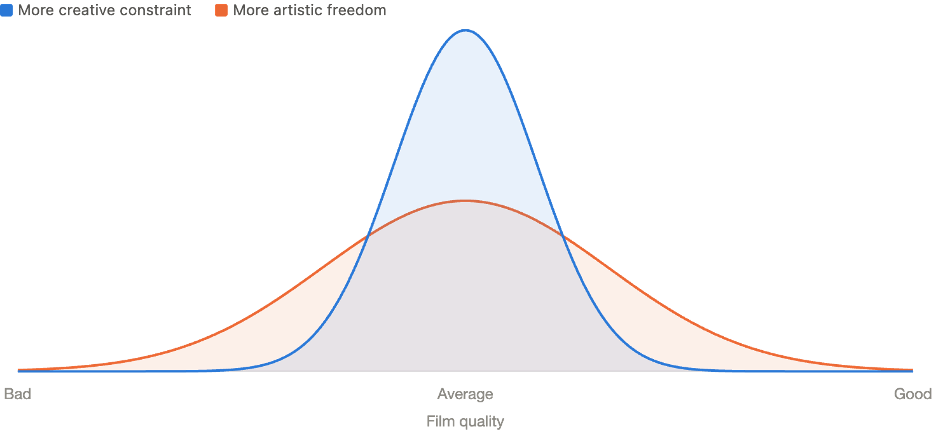
For me as a film fan, the only thing that matters is what’s on the right-hand side of the chart. Everything I want is in that fat orange tail. Now when you add the perspective of history, this effect is amplified: almost all the films are forgotten except for the very best and so you are only looking at the right-hand side because the rest of the chart is invisible to you. Therefore you might find three or four times as many great films in a period of risk and experimentation than you do in a period of caution and consolidation.
This is also where quality and commerciality can differ. The chart above is everything to the artistic side of cinema but a mere sideshow to the business side of cinema. Because the chart says nothing about what made and lost money and how easy it was to position oneself with the profits.
This is not to say that artistic and commercial considerations are opposed. They aren’t. There is a big overlap and Claude has helped me illustrate it:
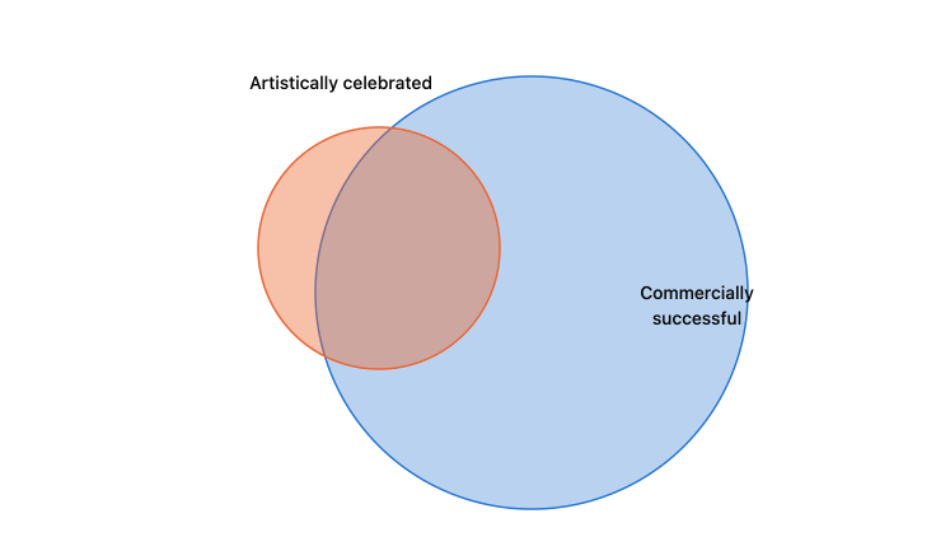
What I’m saying is that on the business side, making films that are artistically successful is one of a number of ways you could try to make money. It’s not the only way – or always the easiest way. This is not unique to the film business. Take any business, really – food is a good example: Good food can sell; it may or may not be your best chance of making money out of food.
So the 50s (till the studios ran for the hills of big-ness) and 70s (till the young Turks ran out of road) look like golden eras, not because film-making generally got better, but the conditions were right for the really good stuff to get over the line.
Nothing lasts. And pendulums don’t just swing back and forth. They swing in spirals. And the next time around, going Big really worked for Hollywood commercially.
When that new wave of gritty American directors was pulling up injured (casualties of excess) and retiring prematurely before the end of the 70s, their replacements were already on the field. Steven Spielberg and George Lucas emerged in the mid-70s and had hits that set them up to become the Kings of Hollywood as the following decade unfolded – and beyond.
Jaws (Spielberg) and Star Wars (Lucas) changed cinema for ever. The idea of the summer blockbuster, with the whole family sitting next to each other in the cinema, started here. So did the idea that merchandise can make more money than the movie. And the dominance of sequels. The Jaws sequels are not remembered but Raiders Of The Lost Ark (Spielberg) joined Star Wars in spawning lucrative follow-ups, making a franchise the natural consequence of a hit. We expect that now; at the time it was new.
At their best, these new big films like E.T. and Back To The Future, had gripping, original, stories with fantastical, escapist themes. They were light, not dark, but they did both tap into deep feelings that young people have and explore them through plots that were unrealistic but highly relatable.
But, as ever, there was a tendency to think that by copying the most obvious features of those films you could hope to cash in on their success. There was a drift towards big for big’s sake: a sense that if a space ship lands, or the hero swings on a rope, or the special effects department creates a new kind of space creature, we will all be left breathless. As if that was all those films were doing in the first place.
The 80s is the worst decade ever for films. It was like the 60s all over again. People of my generation might reminisce about Ghostbusters, but we can’t watch it now. Films were shallow, cliched and looked tacky despite costing money.
I’ve just checked the top 50 grossing films of the 80s and out of them I would watch Die Hard, Twins, Rain Man, and maybe Top Gun – all from the second half of the decade as the film industry started to find itself again. (The outlier is Back To The Future (1985), which might be the best film of the 80s, but a bit earlier.) And with the exception of Rain Man, they might be good, but they’re all pretty silly. They get us away from thinking about things that really matter to us.
Does the crap period (decline from 1980 to recovery around 1987/88) coincide with the rise of home video, the new threat to cinema?
No. Not quite. Films, according to me, got better at the very point that homes had videos – the late 80s.
But I still like my theory that Hollywood gets more conservative when it’s under threat. For a start, whereas TV rose in the 50s like Godzilla to destroy everything, the home video machine played the content that the studios that were making – so while the movie theatres were under threat, the studios not so much. In fact, smart studio executives were presented with an opportunity.
I think it happened like this. Managed well, the video market was now just an extra revenue stream. So a film started in the cinema, then went to video rental, then to video sale and then to TV. You could sell the rights four times and give the product a longer tail. Also, when people stood in the rental shop and tried to choose what to watch, if they saw a film that looked like another film they enjoyed, they’d give it a try. This meant that copycat films had a steady market.
And that happened a lot. We saw a lot of recognisable genres, particularly Horror, Action and… whatever you’d call that genre which was basically soft porn, following Fatal Attraction and Nine And A Half Weeks.
But that aside, Big was big again, too. The 80s saw the birth of the action genre as we understand it now. This new genre was a world away from Bond films or the work of Steve McQueen and Burt Reynolds, back in the 70s.
The trinity of Stallone, Schwarzenegger and Willis ruled Hollywood. The formula was simple: don’t mess with big, strong, muscly man cos man come find you and fuck you up good. Man get all scratched and sweaty and limp through last few scenes. Man not that bothered about women or nothing really. Man mostly just want to fuck up people who mess with him.
Films had got big, again, and stopped being real, again. I’m not saying nobody tried to do better, but I am contending that nobody much succeeded. The tail on the right-hand side of the diagram withered. There was the art-house, of course. But those films were aimed at critics, not audiences.
Sooner or later, realness was coming. As films got over-inflated, the gap opened up for something with a more authentic feel.
I’d take 1992/1993 as the moment the reaction swelled to a crest. Here’s why.
None of the top 30-grossing films of 1993 were sequels (the previous year’s top 5 contained 3). Originality was outselling repetition. Here are two films to illustrate the point…
Reservoir Dogs, a film very consciously influenced by the 70s films mentioned above, had a limited release in cinemas in 1992. It did a respectable $2m. But it exploded in 1993. Excitement rippled around the film-watching world as Reservoir Dogs went from cult hit to mainstream. It made well over $10m in VHS sales and eventually over $20m in DVD sales. Note 1: The budget was originally put up by a home-video company, not a studio. Note 2: Tarantino, the film’s director, schooled himself by working in a hip video store. Note 3: the VHS/DVD market no longer exists. Remember that when we talk about now.
The Piano made it seem possible for a film to rely on atmosphere, character and visual beauty without being consigned to the art-house margins. It pulled in $40m in North America and perhaps two or three times that in other territories. Oh, and it had a woman in the main role, with her feelings and decisions being the main driver of the story. That didn’t catch on, exactly, but it was still a landmark – something that had been highly rare since the 1950s, when films about, and for, women had been common.
Importantly, both those two films felt, compared to what went before, real. While both of them have far-fetched plots, the time, place, and behaviour of the characters feel excitingly tangible. The characters aren’t living in a world that looks like a film set. One film made you feel you were about to get spattered with spouting blood. The other made you feel like you were about to get soaked by sea spray.
Some people actively prefer the film-set universe. They feel it transports them to a world of imagination. My personal taste is for the look and feel of real life. So maybe that’s a bias running through all of this. But whatever your personal tastes are, I would argue that Big films only work when they somehow feel real, and real films only work when they somehow feel Big.
That’s why I think The Odyssey is seen as such an event. Although Nolan’s films are big - visually, thematically, and financially like plenty of others, there are two things that set his work apart.
1. They feel real. He’s not content to hand over the look of his world to a computer. There is CGI, of course, but if a car blows up, he wants it to feel like a car blowing up – not like a car blowing up in a movie. The dialogue is natural and the performances nuanced. He knows that none of the big things will have their full effect if we’re not immersed in the situation
2. He has freedom. It’s his film. While he can’t just do whatever he likes with the money, he is expected to produce something distinctive and authored. With the big blockbusters, we usually don’t know who directed because it usually doesn’t matter: whoever did them, they would have turned out much the same.
Admittedly, the causal processes behind the shifts and trends I’ve traced in this piece are more complex than I’m admitting. Well-informed readers have probably thought ‘Yeah, but what about…’ at least once. Despite that, by looking at the swelling, swerving, tottering, history of cinema, we can surmise things about what’s happening now. I think History gives us some insight into why so many mega-budget, 2-hours-plus films are being made – and why from an industry point of view, The Odyssey is something special among them, however good or bad it actually happens to be.
History does repeat itself; even though when you’re in the middle of it, it’s hard to know which bit of itself it’s going to repeat this time.
So the latest threat to the cinema industry has been the streaming industry. In Part 2 I’ll look at how the cinema industry has responded (guess!) and how it could respond. But for that to happen… the industry would have to reinvent itself as it never has before.