
Do We Go Small To Get Big?
This is Part 2 of Why Bigness Is Big Right Now. I’ll talk about Obsession, which hit cinemas near me last week. I won’t attempt to review it, partly because this insightful piece by Tony Tost was better than anything I had to say. I want to talk about why some people think it’s also a sign of what we might see more of in the future.
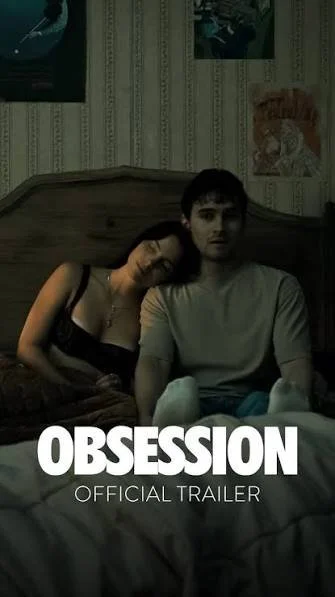
Parts of the film feel like this.
Why do industry-watchers think Obsession’s success, along with that of Backrooms and Iron Lung, is significant. People are talking about these numbers:
Budget Box Office Takings
Obsession $750K $458M
Backrooms $10M $389M
Iron Lung $3M $51M
There are some caveats: there are differing reports of exact numbers; box-office takings are total revenue generated in cinemas, from which all kinds of costs are deducted. But we can compare those numbers with these:
Budget Box Office Takings
The Odyssey $250M $1.1Bn
SpiderMan
Brand New Day $200M $1.7Bn
Supergirl. $170M $125M
Two successful films and one failure. Chat GPT handily illustrates all 6 like this:
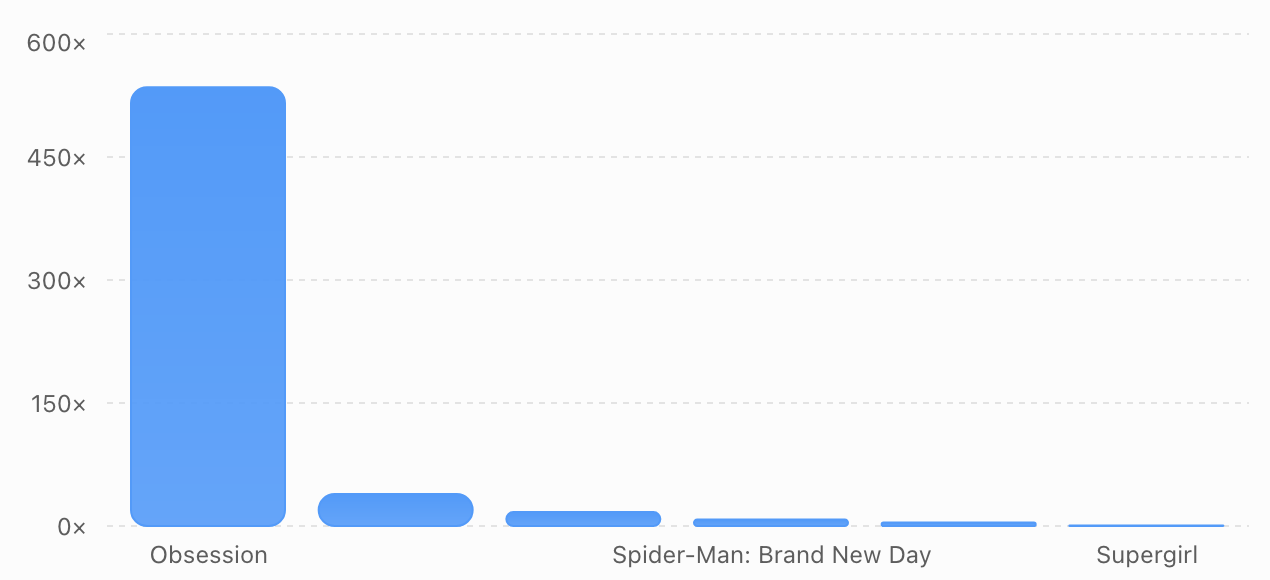
Obsession is an outlier, in this view.
This chart above shows revenue relative to budget, or Return On Investment. Obsession made higher multiples of its budget back than any of the others, so much so that it flattens the others together. From this chart, it’s seem clear which would have been the best film to invest in. But you can see it from other angles, of course…
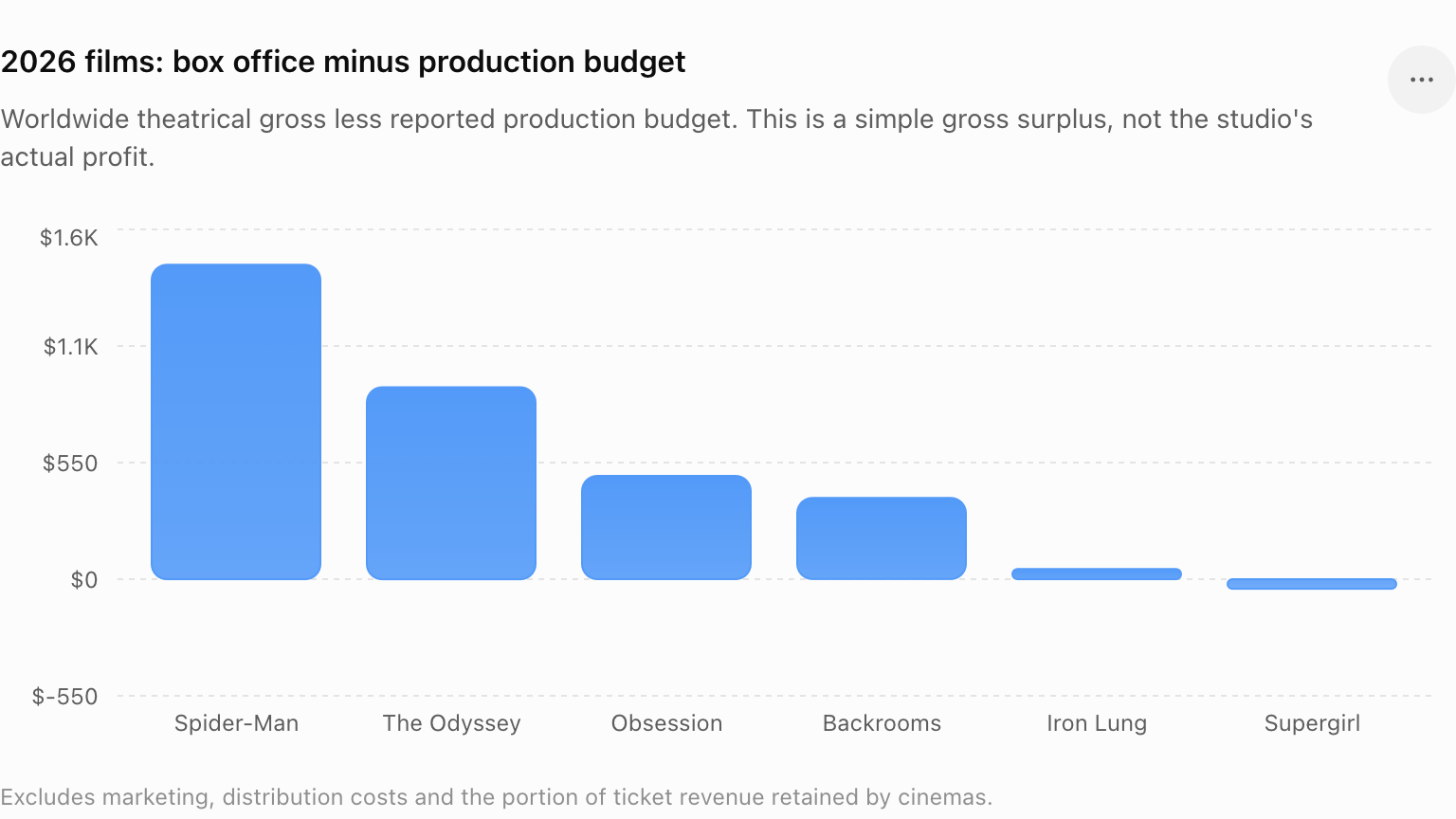
Wait, now Obsession is in the middle. (Supergirl, still last.)
Now we’re looking at how much money got made in absolute terms. And now I wish I’d invested in Spider-Man. The rule is that if you back a blockbuster and it’s a solid hit, you make more money than if you back an independent that turns into a breakout sensation because there is just SO MUCH money on the table with the blockbuster.
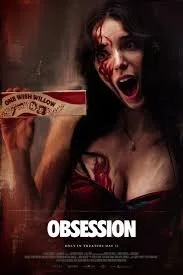
Other parts of the film feel like this
Some people think this explains why studios bet big. I’m not sure. Because what about the losses? Let’s say that with all the costs involved Supergirl lost its investors about $100m (if that figure’s too far off there will be another film for which it does fit). With the losses from Supergirl you could make over a hundred films at the budget level of Obsession. Is that so obviously a worse bet?
Studios are not run by stupid people so I’m probably missing something. But either way, this is not only a matter of a few runaway hits. I want to look at something Obsession (and the two other small films) did differently. First, let me lay out what always used to happen, so we can see what the upstart movies did that was different.
I mentioned that box office takings are not pure upside for the initial investor. The cinemas, the distributors, and all kinds of other people have to be paid their share before you see a net profit. There’s that. But there’s another thing - and that’s marketing. Marketing budgets are not routinely disclosed but, once the costs of production (shoot it, edit it, etc) have been met what do you think the marketing spend might be in comparison to the production cost?
Well, 100% is a likely figure. It will vary but, yes, you might expect to spend the same amount on marketing a film as you did on making it. Or more. Famously, Anora was 1:3: $6m on production and $18m on promoting it (including the cost of the Oscar campaign).
Little indie films might not spend as much as 100%. Hopefully, they have a minimal budget but spend it cleverly. But far too often, makers have (unwisely) spent all they can on the making of the movie and have nothing left for marketing. Or the finished movie may look so uncommercial that nobody wants to throw good money after bad by trying to sell it.
The essential thing is that if you don’t have a marketing budget, you might as well save your freshly made movie to a memory stick and throw it in a poisoned lake. Only with a huge effort on the part of a great many people do you and I become even dimly aware of the existence of any film at all. There are so many films out there - and so many things that are not films but also compete for our attention.
OK, so given the challenging background, how did those three films reach the public? And the big news in the industry has been that they didn’t do it by conventional marketing: putting posters on buses, running TV ads, and doing a tie-in with McDonald’s.
They built the audience first.
It feels like if I had a pound for every time I’d read that sentence I just typed, I could fund, well… maybe not the next Marvel/DC superhero clusterbomb… but certainly my own film.
Build your own audience - what does that mean? Basically, it means you must amass followers. These followers need to be people who actively wish you to succeed. They identify themselves as fans or supporters of your work and are proud to spread the word. Your success is your tribe’s success.
Here is how each of the film-makers behind those three hits is supposed to have done it:
Obsession - Director Curry Barker built an audience for his videos and films on YouTube.
Backrooms - Kane Pixels had an online following for his viral videos
Iron Lung - Markiplier brought almost 40m people subscribers from YouTube and the film was based on a horror game.
These loyal audiences anticipating the release of the film are not just likely to see the film (whether online or in the cinema), they are likely to promote the film before and after seeing it. That’s more powerful than ads - and basically, free.
Admitted, ‘building your audience’ online is easier said than done. The internet groans under the weight of the millions of influencers and hopefuls straining to catch our interest. We swat them away as we scroll to find people we want to hear from. Joining that undignified cacophony is a daunting prospect for many of us.
But the simple fact is that if you’re already ‘somebody’ offline (your reputation is established with the public), assistants can convert your brand into a social media presence. If you’re not already ‘somebody’, then you have a choice between being somebody online first or being nobody.
But it might not be as gloomy as all that for anyone who wants to live life outside the socials. Curry Barker built his audience online by posting films online - by doing what he wanted to do, proving that people liked it, and then getting the money to make a low-budget first feature. He didn’t have to turn silly tricks and slap them all over Instagram.
What we’re looking at is - potentially - the biggest change in the business model we’ve ever seen. Since the beginning of cinema, the main barrier to entry has been the huge cost of making films: the cameras cost a fortune, the actual physical film to put in it cost a fortune, lighting a space for the cameras to work in cost a fortune…
All those barriers are gone. You CAN spend a fortune to make a film. And you can try to use that cash to try to win out over the less well-resourced competition. But the minimum costs to tell a story smoothly have plummeted with modern tech. And when you’ve made a film, you no longer have to persuade a cinema to screen it, or a broadcaster to show it - you stick it on the net.
How do you make money back that way? People are still working all that out. The audience doesn’t have the habit of pay-per-view with films. But if they know they really want to see it, they might seek it out and pay. And if your film has enough appeal with the public then the cinemas will want it, for sure. They just need to be confident your audience is going to show up.
This could be very liberating for film-makers. We could see an explosion of fresh, cheaply-made films appealing much more directly to the audience - not via marketing campaigns, or festivals and critics and TV ads etc.
But there are plenty of ‘ifs’ in that logic. And it’s worth noting that the original films breaking through now are Horror films. Horror has always been the rebel genre, making money when it shouldn’t. Horror directors have used the cheapness of their locations and cast in their favour - you don’t make horror films with stars in swanky locations. You find a cabin and a bunch of actors who just want to work. I’m not saying that’s a formula that guarantees hits - far from it. But good film-makers can break through that way.
Could it work with other genres? Conventional wisdom says you could make a very cheap movie in these genres and it turn out good:
Crime
Comedy
Romantic Comedy
Are there examples?
Well, no. I can’t think of any recent low-budget films in those genres that have worked, actually.
Go back far enough and they do exist: Lock Stock & Two Smoking Barrels, Four Weddings & A Funeral, My Big Fat Greek Wedding, The Full Monty.
And could it work with films that don’t fit any genre - that are ‘dramas’? It’s reckoned to be even harder to find an audience for those, even with a big budget.
Three of my four current projects fit those three genres. The one that didn’t, Game Face, I originally planned as my debut film. But some long months of trying to prepare it for market convinced me that, because it was a drama, it was too hard to sell upfront.
I’m not a horror writer. I don’t watch much horror and you have to really love a genre to do well in it. But I believe I can break through in crime or comedy.
Someone may well beat me to it. I hope so. Because one success paves the way for another: one hit rom-com makes people look for other Rom-Coms to watch, and so on.
Will the studios pivot and fund a hundred low-budget films instead of one Superboy/Irongirl/Batpanther or whatever lies at the bottom of the comic book barrel? Maybe not. This brilliant podcast by Tim Harford explains why market leaders almost never manage to head off emergent technologies. But you never know. I’m not in the prediction business. But I am, most definitely, in the optimism business.
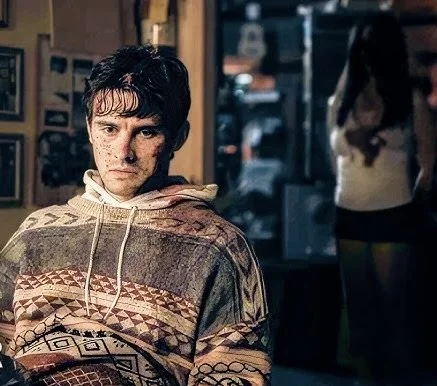
Aah, what have you DONE, mate??