
Two films with (almost) the same title, both about a dinner party where shocking secrets emerge, both set in one building.

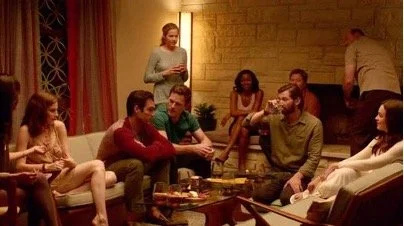
Two dinner parties - can you tell which is the dark comedy and which is the psychological thriller?
This is not a debate about the correct noun of the verb to invite. It’s about two films with almost the same name. They also have almost the same premise, and are both shot almost entirely in one location.
People are saying The Invite might win an Oscar or two. The really head-turning thing about the film is the cast: Seth Rogan, Penelope Cruz, Ed Norton, and Olivia Wilde. You’d bet on one of them getting a nomination. Wilde also directed, so she’s in the running for that, and the screenplay (in dialogue terms at least) is ear-catching.
The Invitation (2015 – not the 2020 Horror film of the same name!) didn’t make much impact on release. I watched it this year as I was researching films that are set in a single location.
The shared title Invite/Invitation points to a shared story premise and story structure: a couple are invited to dinner, things get awkward, then weird, then things really kick off. So they are both examples of the Dinner Party From Hell sub-genre (hereafter, DPFH), about which I will have something to say in a while.
They are different types of film, though: The Invite is a dark comedy; The Invitation is a psychological thriller
For what it’s worth, I would say The Invite is a good film. If you’re looking for something to watch on the streamers, definitely watch it. It is entertaining and full of impressive things.
You can tell there is a ‘but’ coming, can’t you? I do feel a bit churlish to take issue with this movie – because I really do think that you will enjoy it. My aim with this substack is for people to end up wanting to watch things or to get more out of what they’ve seen – not less! I only hope that my list of gripes makes interesting reading without putting you off watching it or spoiling it when you do.
So, here come the gripes.
The first two are with the DPFH sub-genre itself. God, I have seen so, so, many of these, mostly in the theatre. It goes like this: a middle-class family or set of couples gathers for a festive or formal occasion. Then shit goes down: people drink too much, truths get told, relationships are either destroyed or are resumed only after being dragged through the mud. And the universal truths explored by these dramas seem to be that:
Truth 1: Under middle-class satisfaction lurks hypocrisy, fear, resentment, self-loathing, etc.
Truth 2: You can never leave a dinner party.
So number 1 here is about what the drama supposedly delivers. Number 2 is about what holds the plot together.
I have a problem with number 1 because we were shown those things back in the 70’s with (in Britain) Alan Ayckbourne’s plays and Mike Leigh’s Abigail’s Party. Is there anybody who doesn’t already accept that middle class lives are built by repressing or marginalising tensions? Is anyone surprised that the dinner party descends into disaster? And then there are all Tennessee William’s plays and Who’s Afraid Of Virgina Woolf? – charting the implosion of couples and families. All done without resorting to stereotypes. I’m coming back to the stereotypes – I’m just getting started.
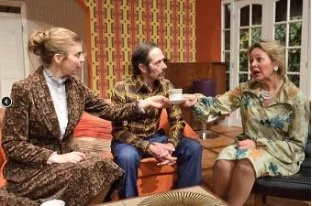

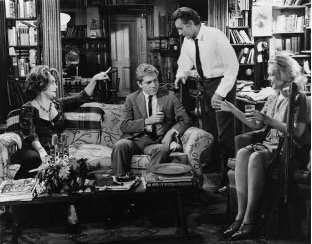
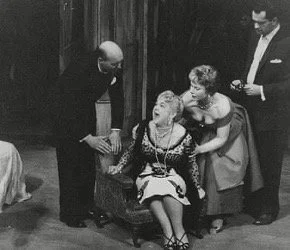
Oh dear, some of these people have had too much to drink…
As for number 2, the plot relies on the fact that, having assembled, the characters will stay in the same room, at each other’s throats. Why doesn’t someone just call a cab? I mean, I know it’s awkward to just get up and leave someone’s house but you could. I would, if someone got drunk and started telling me what they’d always wanted to tell me and it’s about time I heard it. Come to think of it, it happened once, and I did.
There needs to be a purpose each of them is pursuing by staying there, not just inertia or embarrassment. In real life, no doubt, people do sometimes blow up at each other and then sit back down and try to go on with the evening. But that’s not a drama, it’s the opposite of one.
While these points might seem minor, they are really important if we’re trying to sustain a story in a single location.
Why Gripe 1 Matters: Flaming rows are not drama unless someone does something. Information revelation is not drama unless someone does something.
Why Gripe 2 Matters: The characters need a reason to stay put or they’re not driving the story, they’re just sitting in it. Just as when characters are heading somewhere, they need a reason to go there. You can’t put (or keep) characters in rooms just because that’s where the next scene takes place.
While I’m at it, I have a third gripe. I said I’d come back to stereotypes. Well, this doesn’t apply to the whole sub-genre of DPFH but The Invite is one of the many where it does.
1. The feckless middle-class husband
Here are his characteristics:
· neglectful of wife’s emotional needs/life
· passive-aggressive when accused of neglect
· morally complacent
· capable of resentment and jealousy but not ambition
· reluctant to do chores, forgetful of duties
· immature, clinging on to football or music from his youth
· witty, but always with a cynical edge
· pathetically adulterous or pathetically desirous of adultery
In short, he has all the sins of masculinity without any of the virtues. And he doesn’t have those sins on a dramatic scale. He’s just a bit of a prick. His characteristics are trivial and therefore he trivialises the story.
[By the way, and in contrast: the dads/husbands in Adolescence were not stereotypes; they were portrayed as real men with understandable flaws. Was this because they weren’t educated and middle-class?]
By the way, to complement the stereotypically feckless husband, you have the stereotypically anxious wife. I’m not going to attempt the same analysis of that stereotype because the needle on the rant-ometer is edging into the red, but lo and behold, here she is in this film too.
While I don’t want to get side-tracked by these points, they are relevant to my mission of learning about how to make a single-location film work. If the characters are stuck in a room (and assuming nobody’s a psycho with an axe or a zombie or anything) it’s the characters that will drive the narrative. So they need to feel fresh, real, and vital to the audience.
Now, I have a suspicion that, despite my moaning, lots of people watching The Invite will indeed find the characters fresh, real and vital. Not least because of clever writing and great acting.
The two characters of feckless husband/anxious wife are played by Seth Rogan and Olivia Wilde. Their performances are excellent, although I didn’t think Rogan managed to get all the way from the comedy to the emotional truth in the final minutes. He wasn’t helped by a tendency in the writing to rely on witty ripostes in a rather formulaic way. [God, could I sound more like a hard-to-please fellow writer?!]
Neither did the writing completely convince me in Edward Norton’s character. If, like me, you’d happily show up to watch Norton do anything at all, you won’t be disappointed by his performance. He’s great. But I just never believed his character was a fire-fighter.
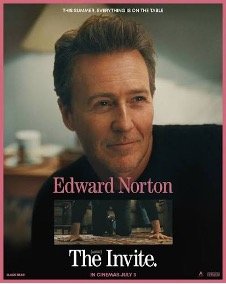
Reckon he’s ever put a fire out?
My vote for the best thing in The Invite goes to Penelope Cruz. Again, I think the over-writing eventually compromised her character but for a good 30-40 mins she’s a real force in the film: smart, sexy, self-possessed, setting the agenda.
So that’s The Invite, the dark comedy, dealt with. I came out of it with these principles about the one-location drama:
· the characters need to go into the story with more than just an itch (this links to the third point, below)
· they need to encounter a bigger threat than criticism/judgement from other people of their class, however much that makes for snappy dialogue
· they have to have to stay in the room
So now on to The Invitation which is the psychological thriller. I’m going to allow myself more spoilers for this one, because I don’t think you’ll watch it and I’m not strongly recommending it.
A guy and his current partner are invited to the house of his ex. He and his ex had a child who died and their marriage didn’t survive the trauma. They are, naturally, both still trying to cope with it. This is a bit of an improvement on the old DPFH formula because there is real emotional weight to that.
The ex has invited round all the ‘old gang’ of friends to spend the evening with her and her new partner. It becomes clear that the ex-and her new man have got involved with some sort of kooky cult. As the evening progresses there are emotional tensions and also sinister hints that the cult-type-thing might be, well, a cult.
And I think that’s the problem with this film. It needs to be either a genre film, whose job is to build the thrills meticulously, beat by beat… or… be a drama. Put another way, it needed to choose whether it’s about a complex trauma or a scary cult. You can have both in the same film but it can’t be about both. If you go for the thriller genre then the trauma part of the story will inevitably be reduced in depth and authenticity – it won’t seriously deal with that subject. And if you are exploring trauma seriously, you can’t end the film with a schlocky bloodbath.
Don’t get me wrong: the last 10-15 mins of the film is pretty good – well conceived and well shot. But that stops the earlier, slower scenes from paying off.
What does it tell us about making a film in one location? Three things, I think.
First, you need brilliant acting. The acting in The Invitation is fine. None of it is weak. But in a single location film, the character is not moving externally so the momentum comes from the internal movement. You need a tour-de-force performance to hold the narrative together. Remember films are shot out of sequence and in a very disjointed way so the actors need to be keenly aware of the point they’re at in the character’s journey. That’s so much harder on a film set than on the theatre stage, where the actor is coming straight off the previous scene. Big stars like Kate Winslet and Anthony Hopkins always seem to fit each scene exactly to the overall narrative.
If titans like that are not available then the director has a big job to do coaxing those finely tuned performances out of the cast.
Second, you need to choose one thing that the film is going to do and do only that. Don’t compromise. And don’t try to do two things at once. You won’t make the script richer; you’ll dilute the impact of the main story.
Before I close off, it might be nice to think of some films that pull off the one-location trick. These are all mostly, if not entirely, in one location:
Twelve Angry Men
A very pure example. Twelve jurymen have to reach a verdict in a murder trial.
Murder On The Orient Express
Hercule Poirot is stuck on a train in the snow after a murder, with all the suspects. Like the jurymen he has to figure out what happened. Like Twelve Angry Men, it’s directed by Sidney Lumet.
Reservoir Dogs
There are lots of flashbacks but the main part of the action takes place at the hideout.
Misery
After a car accident on a remote road, a writer is rescued by a woman who turns out to be his biggest fan – and a nutcase. She ends up imprisoning him until he agrees to rewrite his recent work.
The Shining
A writer and his family are alone in a remote, empty, hotel out of season. Like Misery, it’s adapted from a Stephen King novel.
Any number of horror movies.
They’re stuck in a log cabin miles from nowhere. They start dying one by one.
It’s worth me noting that with all of these films:
· There is a clear and simple reason why the characters are confined to that location.
· The stakes are life-and-death issues, not etiquette or neurosis.
· The actors are brilliant: James Caan, Kathy Bates, Jack Nicholson, Albert Finney, Ingrid Bergman, Henry Fonda, Harvey Keitel, Steve Buscemi…
The takeaways for me, then, are mostly at script level. That suits me because if they are solvable by me, I can solve them at my desk. However, I won’t be working with huge stars. I’ll need unknowns who are unknown because they’re undiscovered.