
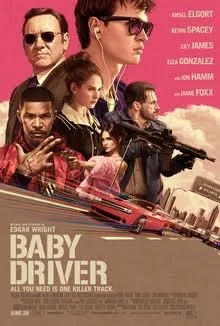
This film is a good idea for a poster
I’ve been watching some bad films. My son and I were touring the streamers, looking for something to try. We had a go at War Dogs, Baby Driver, Hit Man and Tag. None of which I’d expect you to have seen. Actually, I enjoyed War Dogs but I hated Baby Driver, gave Hit Man 5 minutes and Tag about 10 - my teenage son gave it a bit longer but gave up.
All of those films did well, commercially speaking - some only moderately well, but if I was putting the money up for a film, ‘moderately well’ would be a win: it means you’re still in business. What I found demoralising, I have to say, was the mechanical, formulaic pattern: the predictable plot, characters, and dialogue.
The best way to describe the problem might be to take the example of the film I actually liked - War Dogs, which contains many of the faults of the others but is just… sort of the kind of film I usually like. It is based on a true story of two young Americans who figure out how to get rich fulfilling government arms contracts for Iraq and Afghanistan in the 2000s. They go too far, get in too deep, and cross ethical lines. One of the guys is relatable: morally questioning what they are doing and keen to provide for his girlfriend and child. The other is a beast: casually sexist and racist, egotistical, duplicitous, and greedy. Played brilliantly by Jonah Hill.
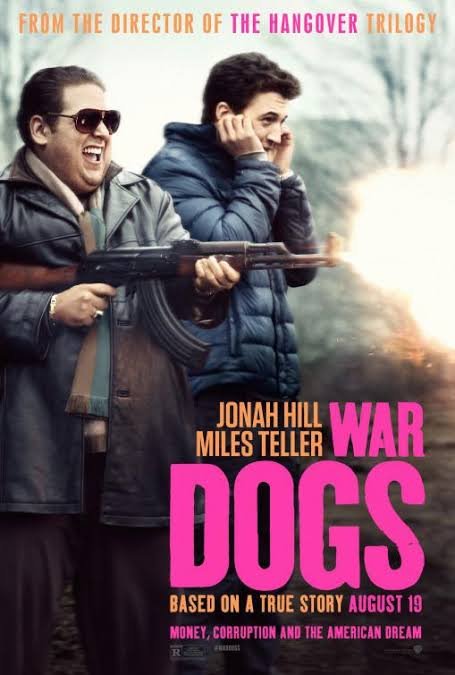
Guess which one is the asshole
Jonah Hill is playing pretty much the same character as he did in The Wolf Of Wall Street. That’s not a criticism of Hill. But the Scorsese film is a clear model for this one.
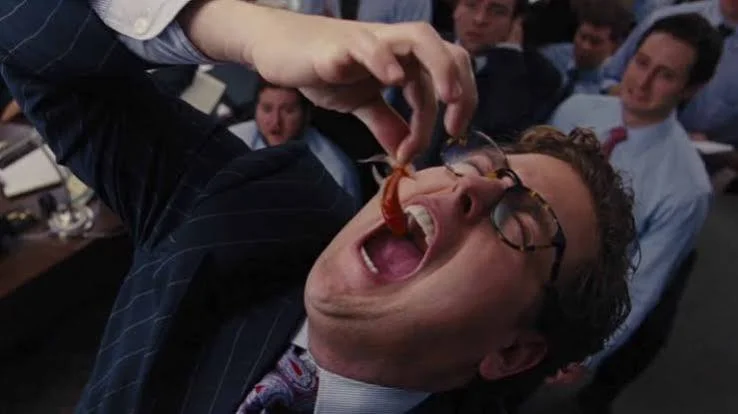
It’s not a chilli. It’s a goldfish, if you look. Actually, maybe don’t.
Both are based on true stories of when things go wrong in business because of the single-minded pursuit of profit. There is a formula for this kind of film:
Male ingenu is down on his luck, needs a break
He meets a mentor, who shows him how to stop being a schmuck and make a buck
Things go well, it’s exciting and fun, while our antihero crosses a few lines that don’t seem too important
The mentor is exposed as evil and capable of turning on our guy. Those moral lines that were crossed now seem to have been important.
Our antihero has a chance to bail out as things get hot - doesn’t take it (OR wants to bail out but is blackmailed/threatened to stay in)
He desperately tries to hold things together as the net closes and his life collapses around him
He partially redeems himself by shopping the evil mentor to the authorities
The Wolf of Wall Street is a slight twist on this formula. Wall Street (1987) fits it exactly - as does another Charlie Sheen classic. That’s right, step back and you might notice this is also the plot structure of a whole bunch of mafia movies (eg Goodfellas). The formula is well-established.
And there is nothing wrong with following an established formula. Plenty of great songs, plays, novels and films do. But the thing is: when it’s done well, we don’t notice. We might feel some sense of recognition as things fall into place. But the reason we don’t notice the known formula is that the writer makes it feel fresh by adding a layer of original or surprising material that stops us finding the familiar patterns predictable. Or they twist the formula in an unexpected way - using our knowledge of the formula to pull surprises on us.
But when it’s not done well, it feels cynical and tired.
But we succumb to cynicism ourselves if we sneer to readily at the motives of the makers of the films. Two reasons. One: I’ve been part of a writing process myself where the finished product was unoriginal and that wasn’t my - the writer’s - fault. It was the process that limited the artistic ambition. Two: I understand that the film industry is an industry and therefore needs to have industrial processes and an industrial mindset in order to exist at all. Granting that, the eternal conundrum has been to have an industry that supports artistry within it - somewhere within it, if not everywhere. The artist fights for the artistry within the system.
As far back as 1924, Charlie Chaplin complained about the process. He published an article in the Adelphi magazine with the title Does The Public Know What It Wants? He takes the studios to task for assuming that the reason a film is a hit is because of certain superficial characteristics, such as genre or subject matter, then rushing to produce a copycat product. So if a costume drama is a hit, the studios rush to make more costume dramas because the public have supposedly revealed their taste for costume dramas in general by going to see one. Chaplin points out that the reason they went to the costume drama was because it was a good film. And what they want next is another good film, not another costume drama.
Some of what he said holds true. Like the tendency to rush towards the last big thing. The success of low-budget horror films Iron Lung, Backrooms, and Obsession has led some people to believe that low-budget horror films are the thing everyone should be making right now. But that overlooks three things:
low budget horror has always produced breakout blockbusters (e.g. The Blair Witch Project)
lots and lots of low budget horror gets made and does badly - always has
good horror films can be cheap to make, but it’s the good that matters, not the cheap
A process that seeks profit by copying successful precedents is not always bad business. But it’s usually bad art. And when we call it ‘writing by numbers’, that’s sometimes literally true. Even before AI, executives in film and TV were using numbers to make decisions about which stories to tell.
This shouldn’t be a big surprise. All corporations use data to make decisions and would be stupid if they didn’t. A committee/data-driven/AI approach might not lead to ‘great art’ but it does help you protect against utter disasters.
Of course, art is different from oil, fridges and legal advice: it’s more difficult to reduce to a metric. But it can be done. And that’s where formulaic film-making comes from. So if this writing-by-numbers approach reduces the artistic value - and possibly the audience’s enjoyment - why does it help sell the film?
Well, part of it is marketing. You have to market a film: people need to know the thing is on. And to understand marketing (I mainly don’t) you have to understand that there is a difference between what consumers enjoy and what they buy. If I make a product that consumers will buy, whether they enjoy it or not post-purchase might not be a worry; the money’s in my pocket now. If, on the other hand, I make a product that consumers would enjoy if they bought it but they don’t buy it, I lose money and the audience never finds out what it missed. So a marketable film can make a profit. An unmarketable film almost certainly can’t.
So it may be that the whole goal of creating the film is to deliver to the marketing team something they can work with. If they can do a poster or a trailer or publicity pack that will attract people to the film, they can sell it. And if the marketing people can sell it, the studio should make it because people will see it. So even if a film is artistically ambitious, it will still need to have a marketing angle just to break through into public awareness. After that, if word-of-mouth is good, it can build its audience. Without the initial marketing boost to get a few bums on seats, no word-of-mouth can get started.
This explains the two edifices we currently see at opposite ends of the business. One edifice is the system of festivals, awards, and critical acclaim. This is all marketing. All of these institutions co-exist to market films that wouldn’t otherwise make it in the mainstream. Some films with artistic pretensions/aspirations are consciously engineered to attract the up-market cinematic establishment. Does it make the films better or worse if they do that? Maybe that’s the wrong question. I think it makes them ‘safe’ in other ways. For example, if your film challenges a progressive political agenda in any way, well, that would be the wrong kind of brave.
The other edifice is IP (Intellectual Property). This term has come to refer to pre-existing material that films are based on, especially franchises like Marvel, DC, Jurassic, Star Wars etc. and video game spin-offs. IP is hyper-marketable because you already have an audience. They will go and see the new film even if they hear bad things about it. Both my sons went to see the Minecraft movie, even though everyone had told them it was bad, because… because it was the Minecraft movie. They said it was bad.
So with established IP you de-risk the project by spending so much on exploiting a recognised brand/world that you kind of force a return - you hope. It doesn’t always work. Some of those films flop too. But, you know, it’s more of a plan than ‘Let’s hope people dig our cool movie when it comes out’.
So what is the damage that these de-risking processes do to stories? What do they look like when they’re designed by committees, or algorithms, or - next - AI large language models?
The easiest way to illustrate the problem is to look at jokes. Jokes have a certain form or shape. Let me tell you one. Background: you need to know that in France, they apparently used to tell jokes about Belgians because Belgians are supposed to be stupid. (I’m going to assume that no Belgians will read this and nobody will get offended on behalf of Belgians.):
Why did the Belgian walk round the supermarket looking at the floor?
He was trying to find the low prices.
So it’s undeniably a joke. And it’s undeniably unfunny. Here are three reasons why:
Like a lot of weak jokes it relies on a single element - the two meanings of the word ‘low’. And the double meaning isn’t interesting or surprising.
There is no context or texture. If a stand-up told this joke they would create a story around it ‘I was in the supermarket the other day and…’
It uses a well-known format without providing any twist on it.
Now, you take those three problems and transfer them to a piece of music. And it’s easy to imagine:
Relies on one element (eg a single simple melody)
No context or texture (eg no phrasing or timbre - no musicianship - in the playing of it)
A well-known format without a twist (eg there is no interesting development or surprise)
I’m not talking about a need to be highly sophisticated. I mean that even a bubble-gum pop song can still be inventive and clever if it avoids these traps.
The same with a film. It could be a crowd-pleaser but still be smart and fresh. Although I enjoyed War Dogs, it is not that smart or fresh. Some aspects were very well done - the dialogue was snappy and the performances excellent. Everything was in place. But to be a film that I would recommend people watch it needs a little more.
As for Baby Driver, it’s like a case study in how to fall short in every single way. Everything is a cliche. And parts of it try to copy other films and fall flat.
For example, the lead character, it is established, is crazy about music. He has tinnitus (car accident, both parents died) and music drowns it out. So we watch him enjoy music on his iPod (it is 2017 - but written somewhat earlier, apparently). Does that sound uninteresting? It is very uninteresting. Anyone could have told them that watching a character enjoy music does not work. There is a rule here: in a movie, unless it’s a dance scene, the character shouldn’t be listening to the music.
When John Travolta walks along the Brooklyn sidewalk in the first minutes of Saturday Night Fever, he can’t hear Stayin’ Alive by The Bee Gees. We hear it, he embodies it. He carries a can of paint as he struts along, he buys two slices of pizza from a shop where they know him, he puts a down payment on a shirt that he sees in a shop window, and he tries to flirt with (OK, harasses) two women in a way that nowadays would set us against him but back then would have been seen as cheeky charm.
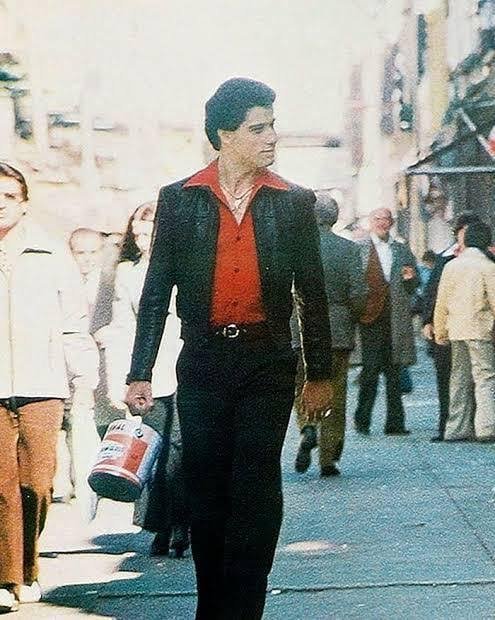
What’s he seen?
We have a similar scene in Baby Driver. Baby grooves along the pavement and…
And nothing. He grooves along a downtown sidewalk and listens to Harlem Shuffle. That’s it.
So we see the same three failings:
Relies on one element, instead of combining several
No context or texture
Known format with no twist
Saturday Night Fever, on the other hand, combines several elements, has lots of textural detail (that Brooklyn street oozes shabby character), and a twist: it turns out the strutting peacock male has been sent to fetch a pot of paint - he’s a dogsbody. This establishes the whole premise of the film - a man rises above drab circumstances by being a transcendently good dancer. Not saying it’s a great film all the way through but it’s got some great sequences.
The worst thing, maybe, about Baby Driver is that it copies previous films without capturing what made them powerful or adding something of its own.
It was written by Edgar Wright (who has done some good stuff). I can’t help but feel that Wright had Pulp Fiction in his mind. It resembles that film in the way that the Belgian joke above resembles a funny joke.
And I think if you fed Pulp Fiction and a few other bits from your favourite films into an LLM and asked it to write a screenplay based on them, it would come up with something very like Baby Driver.
What AI gives us is what other people previously liked, repackaged. The end result is simplistic, lacks context or texture, and imitates successful content without capturing the secret of its success. That goes for an email or a whole film.
My argument would be that if films are going to be created by data-crunching and imitation, AI might as well take over and films might not change much. At least, second-rate writing might not. First-rate writing is not under threat - for the foreseeable future. Mind you, I don’t know about you but the amount of future I can foresee is less than the time it takes to write this article, so who knows.
Anyway, talking about first-rate writing, in the next Substack I want to talk about two British films I really love that will make anyone believe in the future of film-making: I Swear and Onwards And Sideways.